
Geographic synchronous replication
Geographic synchronous replication
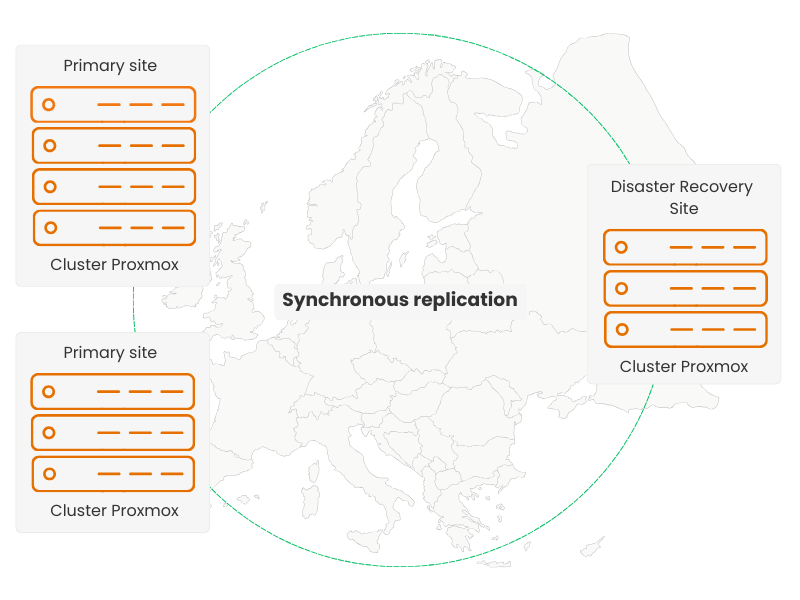
MSDR performs synchronous and continuous data replication between geographically separated Proxmox clusters. In the event of primary site unavailability, the DR site is promoted and VMs can be started granularly: individually, by predefined groups, or in bulk.
MSDR guarantees point-in-time consistency and enables DR site activation operations to manage failover and fallback.
When the primary site becomes operational again, a procedure is initiated to start the replication flow from the DR site to the Primary, and the VMs active on the DR site progressively return to the production site through controlled realignment and migration.
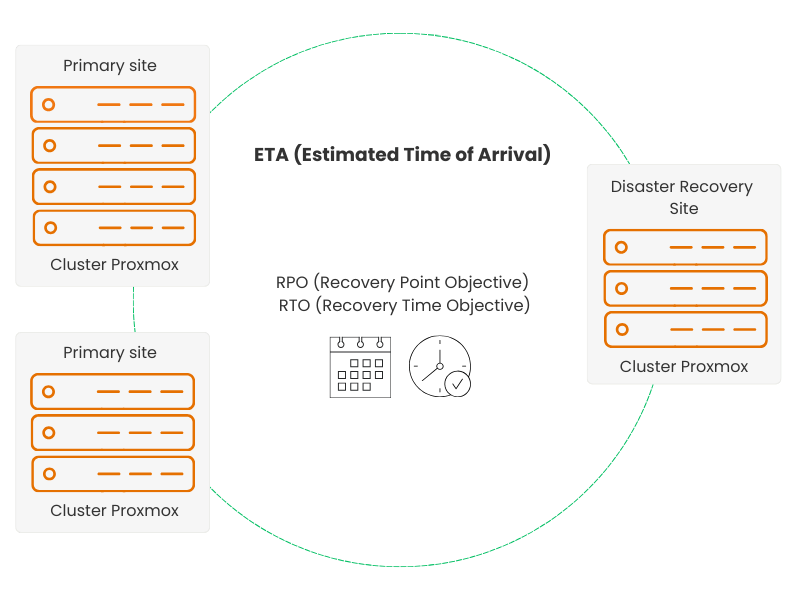
ETA allows organizations to proactively monitor the efficiency of their disaster recovery plan, transforming the concept of replication into a measurable, optimizable, and fully controlled process.
ETA (Estimated Time of Arrival)
The integrated ETA (Estimated Time of Arrival) functionality in the MSDR system provides a real-time estimate of the replication delay between sites.
In practical terms, ETA precisely indicates the time required for an ongoing replication to complete data transfer, taking into account the VM change rate and network conditions.
ETA evaluates the impact of network variability and measures any “backlog” that determines replication lag.
In this way, it offers immediate visibility into the alignment status between clusters and the effective compliance with RPO (Recovery Point Objective) and RTO (Recovery Time Objective) parameters.